Handmade quality chocolate with fewer hands

Producers who want to make handmade, high-quality chocolate often face the challenge that chocolate enrobing requires two people. For many smaller businesses, this makes enrobing less attractive, even though it offers creative possibilities and a unique handmade expression.

This blog post examines the considerations behind the process and shows how one-person chocolate enrobing is possible.

Contact us

Why enrobing is often avoided

Handmade chocolate products are valued for their variety in taste, appearance, texture, and for the stories of creative craftsmanship using high-quality raw materials. It is the combination of creative manual work with high-quality ingredients – possibly wrapped in a story – that gives customers an exclusive, unique experience, motivating them to pay a premium over an industrial product made from lower-quality raw materials.

Chocolate products are usually either enrobed or moulded.
When enrobing chocolate on an enrobing machine, one person must feed the machine, and another must move the finished products from the take-off conveyor. This means at least two people are needed to carry out chocolate enrobing. For smaller producers, employing two staff for this task can be costly.

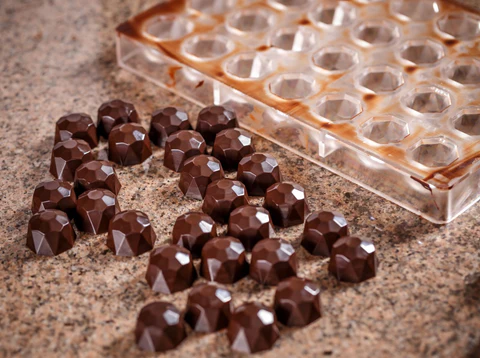
This challenge has led to the popularity of mould filling, which can be performed by just one person. The operator can fill moulds independently and possibly undertake other tasks in between. Industrially manufactured moulds also enable the production of many different fantasy-shaped pralines and figures with a consistent appearance.

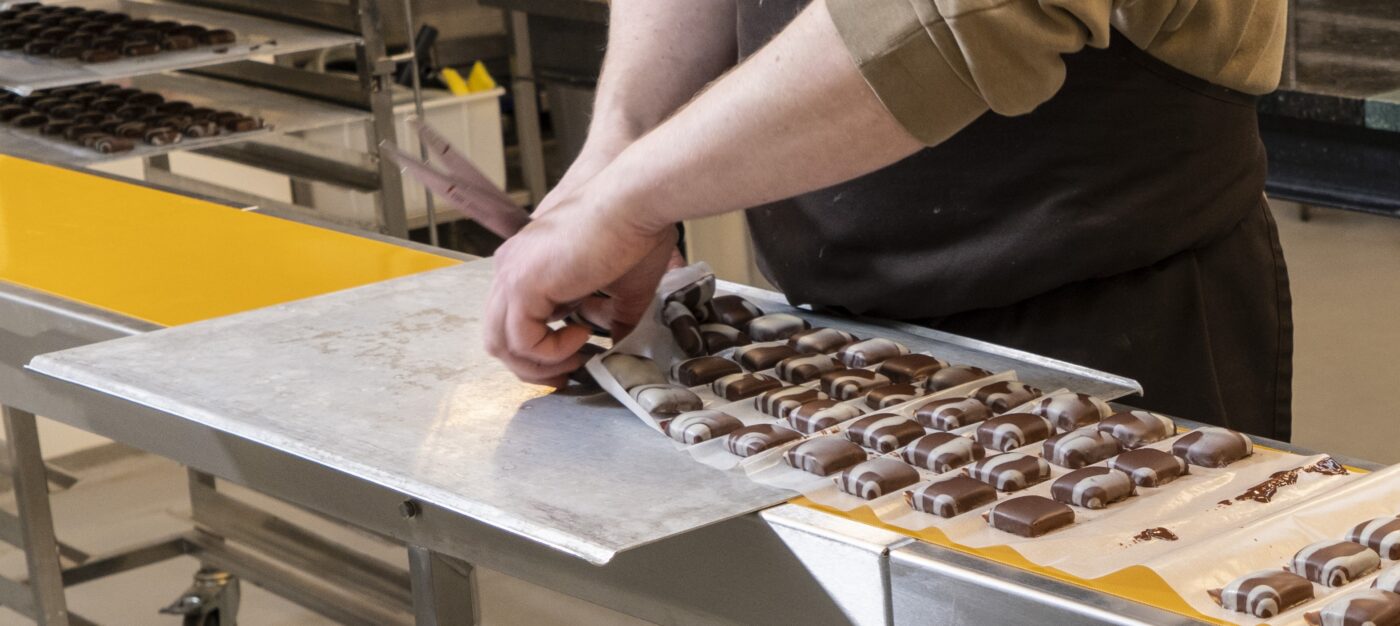
Enrobed pralines are most often handmade

This results in small variations that attest to craftsmanship. Enrobing also allows the chocolatier to add creative touches with decorations such as nuts, fruit, or other types of chocolate.

The requirement of two people for enrobing has undoubtedly discouraged many chocolatiers from using this technique. This is unfortunate, as it limits the experience of good and unique craftsmanship.

Imagine one-person enrobing

Imagine achieving a considerable production volume – done by only one person.

Economically rational enrobing opens up a creative space for the chocolatier and supports the production of high-quality handmade chocolate products. This enhances differentiation from industrially produced chocolates.

When single-person enrobing becomes feasible, the handmade variations and personal creative touches can once again take centre stage.

How the system works in practice

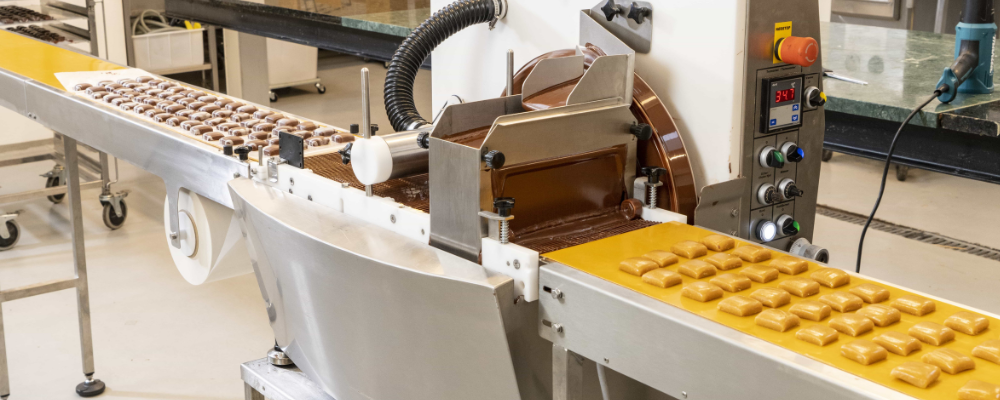
We have therefore equipped our small enrobing machine, model E220, with a system allowing just one person to perform economically viable chocolate enrobing.

The process works as follows:
– Pralines are arranged on a non-moving infeed table before the enrobing machine.
– The infeed table is started manually, which then feeds the pralines into the enrober.
– As the first pralines are enrobed and ready to leave, the take-off conveyor starts automatically to receive them.
– The take-off conveyor stops once all pralines have been conveyed.
– The entire batch on the infeed table is now fully enrobed and waiting on the stopped take-off conveyor—handled by only one person.

The number of pralines that can be placed on the infeed table depends on the capacity of the take-off conveyor. Typically, both are about 1.0 metres long.
In some cases, the infeed table may be 1.0 metres, while the take-off conveyor could be 2.0 or even 3.0 metres.

It is natural to consider how the pralines are handled after enrobing. Usually, they are transferred to a tray, which is then placed on a trolley. The tray’s capacity often determines the batch size.

The length of the take-off conveyor influences how many trays or batches can be enrobed before it needs to be emptied. For conveyors 2 or 3 metres long, 3–5 trays or batches can typically be processed before clearing.


You can see the full one-person enrobing setup in action in the video here