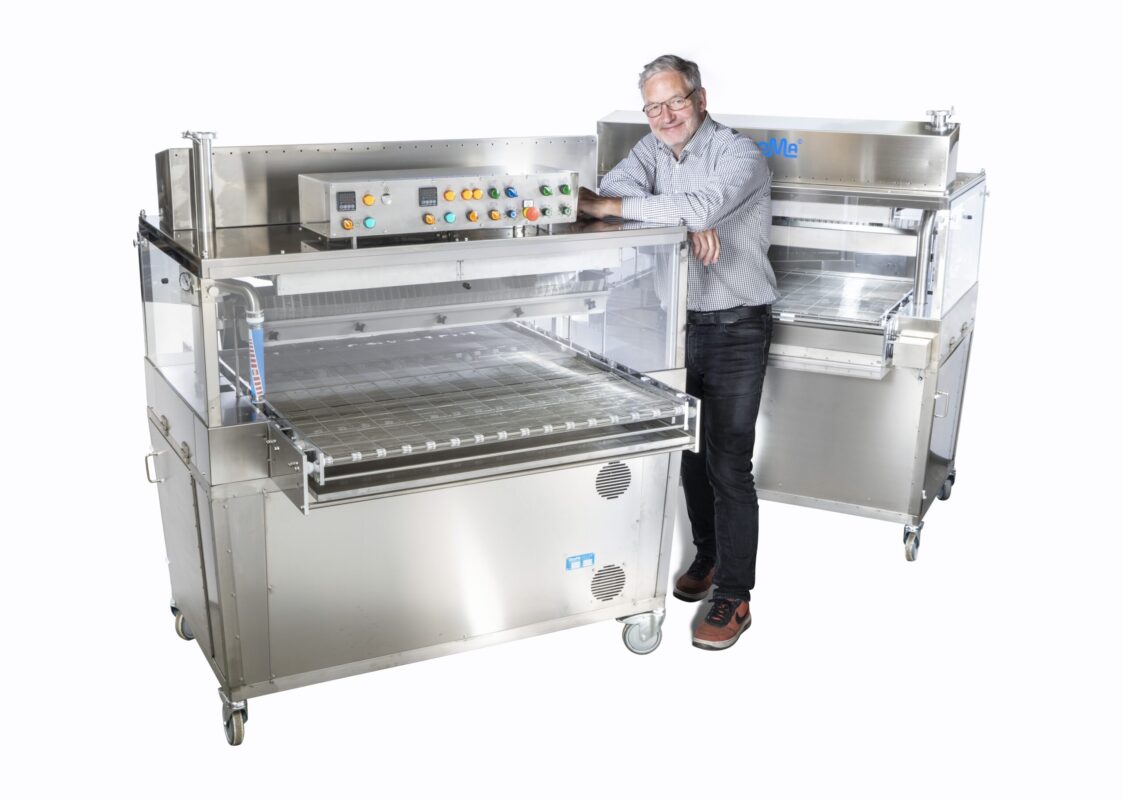
Repair: the usual answer for a machine that still does its job
Most problems on a chocolate machine are wear, not failure. A wire snaps in the mesh belt of an E220 enrober. The carbon brushes in the blower motor of a 2MP enrober wear down. Pump vanes and POM bearings wear, and a gasket stops sitting tight. These are parts that wear through months of running.
The question we hear most often from producers with older equipment is whether parts are still available. Some parts we make ourselves, and those only exist in Chocoma machines. We can supply parts for any machine delivered within the last twenty years, and in practice we usually manage it for machines that are forty or fifty years old. The exception is electrical and electronic components. They come from component suppliers with shorter production lives. When an original is no longer manufactured, we look for a replacement that fits, and we usually find one. We do not present that as a guarantee, because we cannot promise what a component supplier will do fifteen years from now.
If a part has worn out, you replace it. The age of the machine does not change that.
The best time to find wear is before it stops production. We have written separately about planning a service check in a quiet period.
Expand: keep the machine and add another
When the problem is capacity rather than reliability, replacing a working machine rarely makes sense. The machine still does its job. It simply cannot do more of it. Adding a second machine alongside is usually the better route, and it leaves the existing production running while the new machine is installed.
The practical questions are floor space, whether the two machines will run the same products, and whether the line can be split so each machine has its own job. That last point matters more than it sounds.
Økoladen in Ørslev is an example. The company recently invested in a new 2MP40 enrober to supplement its existing 2MP24, a Chocoma machine that has been in operation since 1996. The older machine was neither scrapped nor sold. It now runs white chocolate only, while the new 2MP40 takes the leading role in the rest of the production. By dedicating one machine to a single type of chocolate, Økoladen avoids the cleaning time between product changes that would otherwise cost production minutes. The investment shifted from replacing the old to expanding the whole production. As Økoladen’s CFO, Frederik Elmelund, puts it in the case, the decision was about what the machine costs over its lifetime, not about the price quoted. Read the Økoladen case.
There is a further advantage in adding a machine of the same make: the operators already know it, and the spare parts overlap.
Replace: when repair no longer pays
Chocoma machines are built in stainless steel and made to run for decades. Many stay in daily production for thirty years or more. So replacement is rarely about the machine being worn out. In our experience it comes down to three things.
- The parts that are no longer made. Mechanical parts we can supply for a long time. Electrical and electronic components are different, because they come from component suppliers with shorter production lives. When an original is no longer manufactured, we look for a replacement that fits, and we usually find one. When we cannot, the machine cannot be kept running, however sound the rest of it is.
- The machine has reached the age where repairs never stop. As with a car, there comes a point where each repair is still possible, but they come so often that keeping the machine running no longer makes sense, in money or in time. The cost is no longer the part but the stop itself: lost production, staff waiting, a service visit, and delivery commitments that cannot be met. And a breakdown is most expensive when you are busy, which is exactly when a machine that has started stopping tends to do it again.
Or keep what you have
The most common outcome is none of the three. The machine runs, the parts are available, and the capacity covers the orders, so there is no reason to change anything. We would rather say that plainly than suggest otherwise.
Not sure which way to go?
Tell us the model, the year it was delivered, and what the machine is doing or not doing. A photo of the part in question helps. If there is a Chocoma distributor in your country, contact them. They know the machines and they are closest to you. If there is no distributor in your country, write to us directly at chocoma@chocoma.com or call +45 3641 4200.